
Yoga for Anxiety: Simple Poses for Instant Calm
Yoga for Anxiety: Simple Poses for Instant Calm
Active Star
10/28/20253 min read

Yoga for Anxiety: Your On-Demand Toolkit for Instant Calm
When anxiety strikes, it can feel like a tidal wave of frantic thoughts and physical tension. While yoga is often seen as a form of exercise, its most profound benefit may be its ability to serve as a portable sanctuary for your nervous system. For beginners, the goal isn't flexibility or a workout; it's to use simple, restorative poses to consciously shift your body from a state of "fight-or-flight" (sympathetic nervous system) to "rest-and-digest" (parasympathetic nervous system).
These poses are designed to be safe havens. They create physical and mental containers for your anxiety, allowing you to breathe through the discomfort and find a tangible sense of peace, anytime and anywhere.
Your Action Plan: 4 Steps to Instant Calm with Yoga
Follow this sequence the next time you feel anxiety building, or practice it daily as a preventative measure.
Step 1: Set the Foundation – Intention & Environment
Before you move, create the conditions for calm. This step takes less than a minute but makes all the difference.
Find Your Space: Choose a quiet, comfortable spot where you won't be interrupted. This could be a corner of your bedroom, a soft rug, or even your yoga mat.
Gather Props (Optional but Helpful): Have a pillow or folded blanket for knee and head support, and if possible, a wall space.
Set an Intention: Place a hand on your heart and take one deep breath. Silently set a simple intention, such as "I allow myself to be calm" or "I am safe in this moment." This directs your mind away from the anxiety loop.
Step 2: Activate the Relaxation Response with Breath
Your breath is the remote control for your nervous system. We'll use it to dial down the anxiety.
The Technique: 4-7-8 Breathing. In any comfortable seated position or lying down:
Inhale quietly through your nose for a count of 4.
Hold your breath for a count of 7.
Exhale slowly through your mouth, making a gentle "whoosh" sound, for a count of 8.
Repeat this cycle 3-4 times. This extended exhale is scientifically proven to activate the vagus nerve, which is the main command center for calming your body.
Step 3: Practice Your "Go-To" Calming Poses (5-10 Minutes)
Choose one or cycle through both of these beginner-friendly poses. Hold each for 2-5 minutes, focusing on the sensation of release, not perfection.
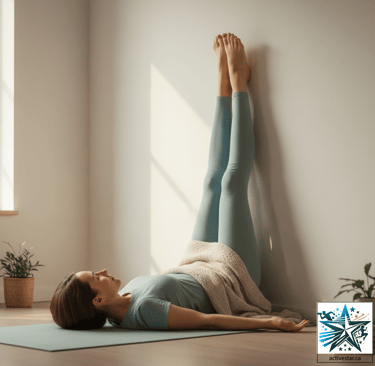
Pose 1: Legs-Up-The-Wall Pose (Viparita Karani) – The Reset Button
Why It Works: This gentle inversion reverses blood flow, soothing the nervous system, reducing heart rate, and relieving tired legs and feet. It feels deeply restorative.
How to Do It:
Sit sideways with your right hip touching the wall.
Gently swing your legs up the wall as you lower your back and head to the floor. Your sitting bones don't need to be flush against the wall; find a comfortable distance.
Rest your arms comfortably by your sides, palms up. Close your eyes.
Focus: Feel the weight of your body sinking into the floor. Imagine stress draining down your legs and out through your feet.
Pose 2: Child's Pose (Balasana) – The Safe Harbor
Why It Works: This fetal-like position creates a sense of security and comfort. It gently compresses the abdomen, which can soothe the solar plexus—an area where we often hold anxiety.
How to Do It:
Kneel on the floor, touching your big toes together and sitting on your heels.
Separate your knees about hip-width apart.
Fold forward, draping your torso between your thighs. Rest your forehead on the floor or a pillow.
Extend your arms forward or rest them alongside your body with palms up.
Focus: Feel the gentle stretch in your back. With each exhale, imagine your spine lengthening and your shoulders softening away from your ears.
Step 4: Transition Mindfully Back to Your Day
How you end your practice is as important as how you start it.
Move Slowly: To come out of a pose, move with deliberate slowness. Roll to your side in a fetal position before slowly pushing yourself up to a seated position.
Take a Final Moment: Sit comfortably for a moment. Notice how your body and mind feel compared to when you started. Acknowledge the shift, however small.
Carry the Calm: Set an intention to carry this feeling of calm with you as you slowly return to your day.
The Bottom Line:
Think of these poses not as exercises, but as tools for emotional first-aid. You don't need to be flexible or spiritual to benefit from them; you only need a willingness to pause and breathe. By creating this short ritual, you empower yourself with a accessible, drug-free way to reclaim a sense of peace whenever you need it most.