
Starting Your Home Yoga Practice: Creating Your Sanctuary
Starting Your Home Yoga Practice: Creating Your Sanctuary
Active Star
10/26/20253 min read
Starting Your Home Yoga Practice: Building Your Sacred Sanctuary
The freedom of a home yoga practice is unparalleled—it's your time, on your schedule. However, the challenge often lies in transitioning from the distractions of daily life to a state of mindful calm. The solution is to intentionally craft a dedicated space that serves as a physical and psychological anchor. This isn't about needing a perfect, spacious room; it's about claiming a small piece of your home that signals to your mind and body: "It is time for practice."
A consistent, personalized sanctuary minimizes distractions, deepens your focus, and transforms your practice from just another item on your to-do list into a cherished ritual.
Your Action Plan: Crafting Your Home Yoga Sanctuary in 4 Steps
Follow this guided process to create a space that inspires you to return to your mat, day after day.
Step 1: Claim Your Corner (The "Where")
Your sanctuary begins by claiming territory. This act alone is a commitment to your practice.
Find Your Footprint: Identify a space just large enough to unroll your mat without obstruction. This could be a corner of your bedroom, a quiet section of the living room, or even a cleared spot in a home office.
Prioritize Consistency: Choose a spot that can remain your "yoga spot" consistently. The more you practice in the same location, the stronger the mental association becomes. Your mind will begin to automatically quiet down when you step into that space.
Check the Environment: Ensure the area has reasonable ventilation and access to natural light if possible. A space that feels good to be in is a space you'll want to return to.
Step 2: Declutter & Define (The "Foundation")
A cluttered space leads to a cluttered mind. This step is about creating a clean slate, both physically and mentally.
Physical Declutter: Physically remove non-yoga items from your immediate view. Put away stray laundry, stack those books neatly, and clear any general household clutter. Your mat should be the central focus.
Digital Declutter: This is non-negotiable. Put your phone on "Do Not Disturb" mode or place it in another room. If you're using it for a guided practice, use a dedicated app mode or turn off all other notifications.
Set Boundaries: Communicate with family members or roommates. A simple, "I'm going to take 20 minutes for my yoga practice for some quiet time," sets a clear and respectful boundary.
Step 3: Personalize Your Atmosphere (The "Feeling")
This is where you transform a simple corner into your personal sanctuary. Engage your senses to create a multi-sensory experience.
Sight: Soft, warm lighting is ideal. Use a dimmable lamp or fairy lights instead of harsh overhead lights. If you have a window, use natural light.
Scent (Olfactory Anchor): Introduce a subtle, calming scent. This could be from an essential oil diffuser (lavender or frankincense are popular choices), lighting a candle for a moment before you begin, or simply having a sprig of fresh rosemary or eucalyptus nearby. The consistent scent will become a powerful trigger for relaxation.
Sound: Decide on your soundscape. This could be purposeful silence, a curated calming playlist, or the gentle use of a white noise machine to block external sounds.
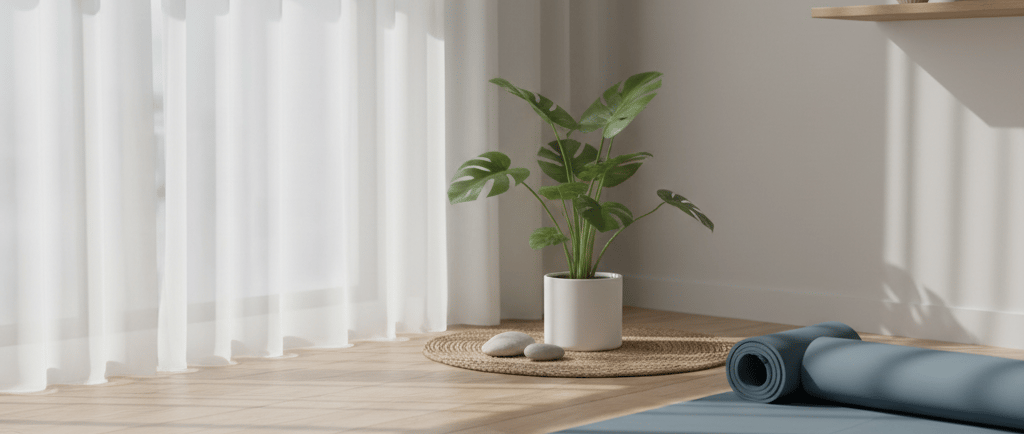
Touch & Sight: Add one or two simple, meaningful objects. A small plant, a beautiful crystal, or an inspiring image can serve as a gentle focal point during your practice.
Step 4: Cultivate the Ritual (The "Habit")
The space sets the stage, but the ritual solidifies the practice. Create a simple, repeatable sequence to begin each session.
The Opening Cue: Establish a simple action to mark the official start of your practice. This could be:
Ringing a small bell or chime.
Taking three conscious, deep breaths at the top of your mat.
Stating an intention for your practice (e.g., "My intention is to be kind to my body today").
Keep it Stocked: Store your yoga props (blocks, strap, bolster) neatly nearby. When your tools are easily accessible, you're more likely to use them.
Honor the Closing: Just as you started with a cue, end with one. Taking a moment of gratitude in a final resting pose (Savasana) or placing your palms together at your heart (Anjali Mudra) provides a sense of completion.
The Bottom Line:
Your home yoga sanctuary is a powerful tool for building a consistent and rewarding practice. It is a physical declaration that your well-being is a priority. By investing a small amount of time in creating this dedicated space, you are not just arranging a room—you are cultivating a habit, a mindset, and a personal retreat that will support your journey on and off the mat.