
Finding Your Yoga Style: Beyond the Basics for Beginners
Finding Your Yoga Style: Beyond the Basics for Beginners
Active Star
11/2/20253 min read
Finding Your Yoga Style: A Beginner's Guide to the Perfect Practice
You've mastered a few basic poses and understand the principles of breath and modification. Now, the exciting next step is to discover the style of yoga that truly resonates with your personality, goals, and energy levels. The world of yoga is beautifully diverse, offering everything from a vigorous, sweat-inducing workout to a deeply meditative, restorative experience. Finding your "yoga home" is the key to transforming your practice from a routine into a lifelong passion.
This guide will help you move beyond the basics and intentionally explore the landscape of yoga styles to find the one that makes you feel empowered, balanced, and eager to return to your mat.
Your Action Plan: Discover Your Perfect Yoga Style in 4 Steps
Follow this framework to move from curiosity to clarity.
Step 1: Check In with Your "Why" – Define Your Intention
Before browsing class schedules, look inward. Your ideal yoga style should align with what you need most right now.
Ask Yourself:
Am I looking for a physical challenge to build strength and stamina?
Do I need a tool for stress relief and mental quiet?
Am I seeking to improve flexibility and joint mobility?
Is my goal to find a moving meditation that connects breath and body?
Identify Your Primary Goal: Your answer will be your compass. For example, if stress relief is your goal, a fast-paced Power Yoga class might be overwhelming, while a Restorative class could be perfect.
Step 2: Explore the Yoga "Flavors" – A Style Primer
Think of different styles as different tools in a toolbox. Here’s a guide to the most common ones you'll encounter:
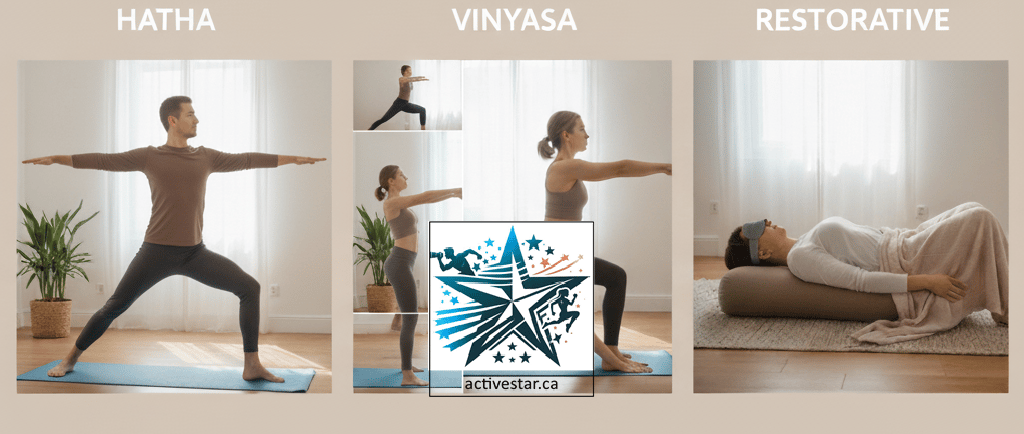
For Structure & Foundation: Hatha Yoga
The Vibe: Slow, steady, and alignment-focused. Ideal for learning the ABCs of yoga.
Best For: True beginners, anyone wanting to master the fundamentals, or those seeking a gentle, grounding practice.
Think: "Yoga 101."
For Rhythm & Movement: Vinyasa or Flow Yoga
The Vibe: Dynamic and fluid. Poses are linked together in a seamless "flow" synchronized with the breath.
Best For: Those who get bored easily, enjoy a physical challenge, and like creative movement. Pace can vary from moderate to vigorous.
Think: "A dance on the mat."
For Deep Relaxation & Recovery: Restorative Yoga
The Vibe: Deeply calming and passive. Uses props (bolsters, blankets, blocks) to fully support the body in gentle poses for several minutes.
Best For: High-stress individuals, anyone recovering from injury or illness, or those needing to activate the "rest and digest" nervous system.
Think: "Active relaxation."
For Heat & Detox: Hot Yoga or Bikram
The Vibe: Practiced in a heated room (often 95-105°F). Bikram follows a strict, set sequence of 26 poses.
Best For: Those looking for an intense physical challenge and who enjoy sweating. Not recommended for those with certain health conditions (e.g., heart issues, pregnancy).
Think: "A sauna with stretches."
For Precision & Alignment: Iyengar Yoga
The Vibe: Meticulous and detail-oriented. Uses a wide array of props to help students achieve perfect alignment in each pose.
Best For: Individuals with injuries, those who love technical details, and anyone wanting to deeply understand the architecture of a pose.
Think: "Physical therapy meets yoga."
Step 3: Take a "Yoga Tour" – Sample Classes Strategically
The only way to know what you like is to try it. Be a yoga tourist!
Leverage Introductory Offers: Most studios and online platforms offer "New Student" passes or free trial weeks. This is your golden ticket to experiment without commitment.
Sample the Spectrum: Intentionally choose one class from different categories. Try a Hatha class one week, a Vinyasa class the next, and a Restorative class after that.
Research Teachers: A great teacher can make any style accessible. Read bios and reviews. Look for instructors who emphasize safety, offer modifications, and have a teaching style that resonates with you.
Step 4: Reflect and Refine – Listen to Your Body & Mind
After each class, take two minutes to check in. How do you feel?
Immediately After Class: Do you feel energized or drained? Agitated or calm? Empowered or frustrated?
The Next Day: Are you feeling pleasantly stretched and aware of your body, or painfully sore? Is your mind quieter?
Trust Your Feedback: Your body and mind will give you the answer. If you dread the thought of another class in that style, it's not the one for you right now. If you find yourself looking forward to it, you're on the right path.
The Bottom Line:
Finding your yoga style is a personal journey of discovery. There is no "best" style—only the best style for you. Your perfect match might even change with your life's seasons. By defining your intention, exploring with an open mind, and listening to your inner feedback, you will find a practice that doesn't just challenge your body, but also nourishes your soul and seamlessly integrates into your life.