
Decoding Food Labels: Your Guide to Smarter Choices
Decoding Food Labels: Your Guide to Smarter Choices
11/3/20253 min read
Decoding Food Labels: Your 4-Step Guide to Smarter Grocery Choices
In a world of clever marketing and thousands of packaged options, the ability to decipher a food label is your most powerful tool for making informed, healthy choices. Moving beyond the flashy claims on the front of the package and understanding the standardized "Nutrition Facts" panel is what separates savvy consumers from confused ones. This skill empowers you to see past the hype, avoid hidden pitfalls like excess sugar and sodium, and confidently select foods that truly align with your health goals.
Think of yourself as a detective, and the food label as your case file. The truth about a product's nutritional value is all there—you just need to know where to look.
Your Action Plan: The 4-Step Label Detective Method
Follow this systematic approach on your next grocery trip to quickly and effectively evaluate any packaged food.
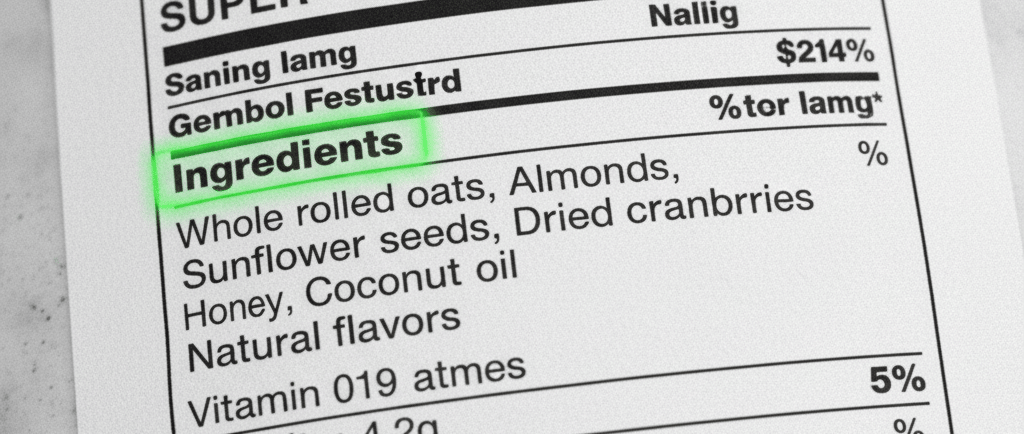
Step 1: Interrogate the Ingredients List – The Golden Rule of Short & Sweet
The ingredients list is the most truthful part of the package, revealing exactly what you're eating.
The Rule of Thumb: Shorter is better. Prioritize products with a short list of whole, recognizable ingredients—the kind you might find in your own kitchen.
The First Ingredient is Key: Ingredients are listed in descending order by weight. The first few ingredients make up the bulk of the product. If the first ingredient is sugar, a refined flour, or an industrial oil, it's a sign the product is not a nutrient-dense choice.
Beware of Sugar's Aliases: Manufacturers use dozens of names for added sugar to split it up on the list. Be on the lookout for words like: cane juice, high-fructose corn syrup, maltose, dextrose, rice syrup, and fruit juice concentrate. If you see multiple types of sugar in the list, it's likely a sugar bomb.
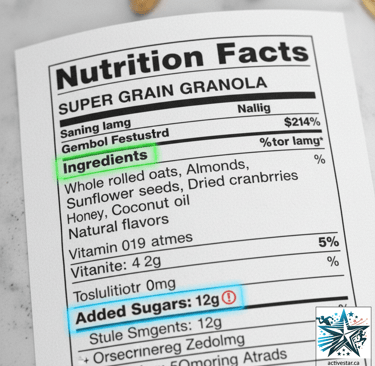
Step 2: Analyze the "Nutrition Facts" Panel – Focus on the Big Four
This is where you get the quantitative data. Focus your attention on these four key areas.
1. Serving Size: The Reality Check
This is the most important number on the label. All the information that follows is based on this single serving.
Ask Yourself: "Is the serving size realistic, or is it a tiny amount that I would easily double or triple?" Always compare the serving size to how much you actually eat.
2. Added Sugars: The #1 Priority
This is the amount of sugar that was added during processing, not the naturally occurring sugar (like in milk or fruit).
The Quick Guide: The American Heart Association recommends no more than 24g (6 teaspoons) for women and 36g (9 teaspoons) for men per day. Use this as a benchmark to gauge a product's sugar load.
3. Sodium: The Silent Saboteur
Excess sodium is linked to high blood pressure. Processed foods are the primary source of sodium in most diets.
The Quick Guide: A good rule is to look for products with less than 140mg of sodium per serving, which qualifies as a "low sodium" food.
4. Fiber & Protein: The Satiety Squad
These are the nutrients you generally want more of. They help you feel full and satisfied, stabilizing your energy levels.
The Quick Guide: For fiber, aim for at least 3-5 grams per serving. For protein, 5-10 grams per serving is a good target for most snacks and sides.
Step 3: Apply the 5/20 Rule for a Quick Gut Check
This is a simple tool to quickly interpret the "% Daily Value" (%DV) on the right side of the panel.
5% or Less is LOW in that nutrient. This is good for nutrients you want to limit, like Saturated Fat, Sodium, and Added Sugars.
20% or More is HIGH in that nutrient. This is good for nutrients you want to prioritize, like Fiber, Protein, Vitamin D, Calcium, and Iron.
Step 4: Compare and Conquer – Make It a Habit
Don't just read labels in isolation. Use this skill to make direct comparisons between similar products to find the healthiest option.
Compare Two Breads: Which one has more fiber and less added sugar?
Compare Two Yogurts: Which one has less added sugar and more protein?
Compare Two Sauces: Which one has less sodium and a simpler ingredient list?
The Bottom Line:
Becoming a label detective transforms you from a passive consumer into an active participant in your health. By mastering these four steps—scrutinizing the ingredients, focusing on serving size, tracking added sugar and sodium, and prioritizing fiber and protein—you can navigate the grocery store with confidence. This knowledge allows you to choose foods that truly fuel your body, making healthy eating a sustainable and empowering habit.